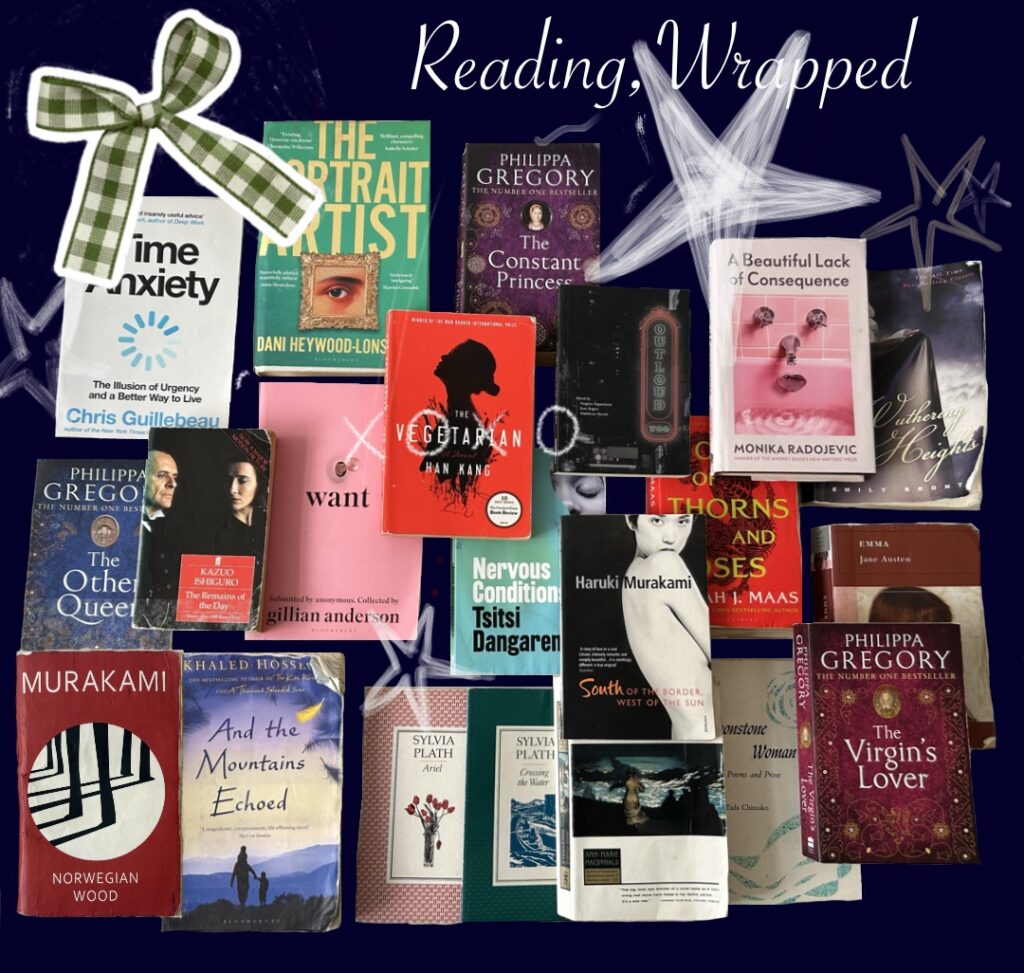
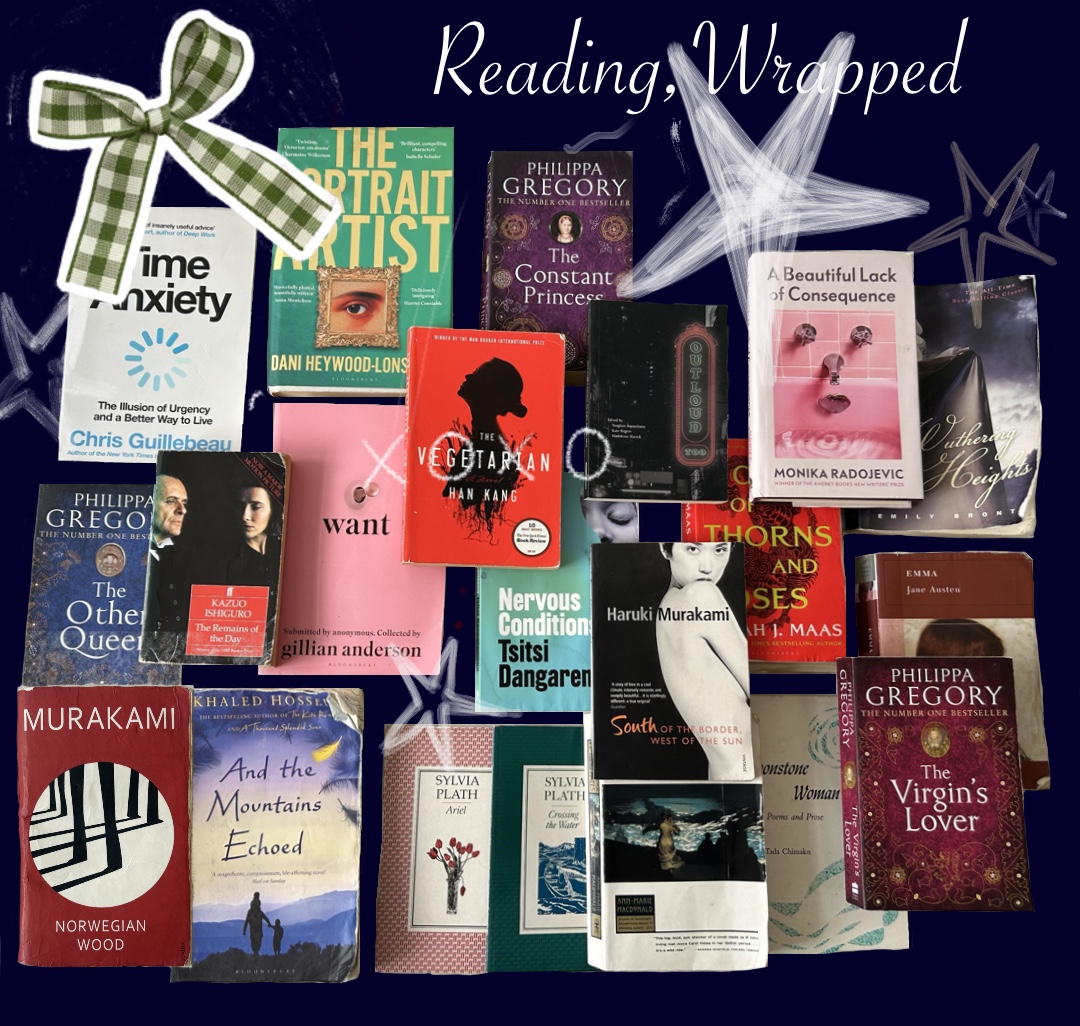
Another year of gobbling fiction as one of my favourite tonics to life. Gregory made another impactful attendance on this year’s list. In 2026, I aim to finish her 16-book Tudor history series, and I am pleased to announce that in my friendsmas Christmas quiz, I still couldn’t put Henry VIII’s wives into consecutive order. It seems it’s all really going in. Once again, my book choices were slightly curtailed by the offerings of my local second-hand bookstore in Hong Kong, with its small selection of English books. This did, however, push me towards new authors (Canadian writer Ann-Marie MacDonald’s Fall on your knees, a delightful consequence of this restraint). So as 2026, the ‘Age of Analog’, dawns upon us, please take this as your sign, if you can, to crack open that book that’s been gathering dust. It makes everything better.
The Vegetarian – Han Kang ★ ★ ★ ★ ★
⋆.𐙚 ̊ Superbly strange and unsettling. This is a unique imagining of marriage and the psyche. The sister’s visualisations of her own precarious ‘thread’ of sanity are particularly resonant. Han’s writing is genius – dream-like and dynamic, erotic and disgusting, simple yet deeply symbolic. She follows visions and stretches reality into places which feel new. It is creative writing at its best. I saw a Hong Kong theatre production of the novel and found the power dynamics electric. Actors, with particularly sensitive microphones, rendered the offending meat-eating in all its lip-smacking, stomach-churning glory.
And the Mountains Echoed – Khaled Hosseini ★★★★★
⋆.𐙚 ̊ An intimate beginning, the quiet storytelling between an Afghan father and his two children, opens up to a vast, global history of interlocking fates and devastating ends. Hosseini’s story moves as something potent, something important, through the minds and bodies of his characters. The shards of the past, or of actions long before they were born, still fissure beneath their skin. We witness the severing power of war and the power of return. This ruined me, in all the right places.
Emma – Jane Austen ★★★★
⋆.𐙚 ̊ The rural gentry through a distinctly Emma-centric perspective. She is comically clinical in love, the self-appointed machinator of society, but her misunderstandings become ours too. Austen unpicks public life and studies it, through Emma’s fastidious gaze, in microscopic detail. This, in my opinion, is not an easy novel. The writing is utter genius, I savoured the absolute perfection of every word, but you are spending up to 500 pages within the stuffy confines of an upper-class Surrey village, where the chief concern is where to hold the next grand ball. My desire for more fireworks with the sensible Mr K probably reveals that I’ve been broken by too many rom-coms.
Remains of the Day – Kazuo Ishiguro ★★★★★
⋆.𐙚 ̊ Stunning, stunning, stunning. Quiet and introspective, Ishiguro drip-feeds us the truth so that we linger on each breath while simultaneously questioning everything that has come before. A privilege to reside in this character’s inner world and experience the collapse of his life perspective. My love for an unreliable narrator endures.
Nervous Conditions – Tsitsi Dangarembga ★★★★★
⋆.𐙚 ̊ A striking coming-of-age novel on the intersections of gender, colonialism and cultural displacement. Dangarembga’s writing is both shocking and beautifully sensitive, delicately navigating the winding life-path of narrator Tambu who wriggles free from childhood constraints into an only wider web of adult identity politics. The novel’s setting steams through the pages and wraps you in warm cooking smells – women pounding maize, the exuberance of fruit trees, and the river rushing from villages into commercial cities.
The Portrait Artist – Dani Heywood-Lonsdale ★★★
⋆.𐙚 ̊ A captivating artist mystery that entertains without leaving much residual feeling. I enjoyed the familiar setting of Oxford, the whimsical air of mythology, and the detailed description of Timothy Ponden-hall’s waxy, resinous, encaustic painting technique. Pacy plot and a real ‘page-turner’.
A Beautiful Lack of Consequence – Monika Radojevic★★★★
⋆.𐙚 ̊ Uncanny and exciting. An exposition of the female experience defined by rage. Radojevic chases emotional experiences into tunnels of abstraction. Missing women become blood-thirsty bees and a talking vagina reveals hidden truths. It’s brilliant because suffering can feel surreal. It can, at times, feel deeply comical. Radojevic is brave and wonderfully abrupt in her delivery of life’s realities. Her writing is both richly imaginative and refreshingly unpretentious. A riveting and rollicking read.
Wuthering Heights – Emily Brontë ★★★★
⋆.𐙚 ̊ In serendipitous earthly preparation for the upcoming Emerald Fennel reimagining, my Hong Kong bookstore turned out a particularly ugly looking copy of this perennial classic. And yes the rumours are true. Reading this without a family tree is like map-reading in the dark. It was a part-reader, part-inspector detective experience, as I sat solo-dining in the restaurants of Japan, drawing feverish lines of relation alongside large notes: DEAD, DYING, DIFFERENT PERSON. It now looks all rather simple in retrospect. This is a pulsing, frantic novel, with so much emotional meat. It’s painful and violent. A twisted, gothic anti-romance and definitely worth the struggle.
A court of Thorns and Roses – Sarah J. Maas ★★★
⋆.𐙚 ̊ It just had to be done. Sarah J. Maas’ TikTok sensation is, I think, the first fantasy romance novel I’ve ever read. My housemate gave it to me after giving up, ‘too many fairies..i’m not into it’. I pressed on and did find it a bit of a scream. It’s mostly highly-digestible, flirtatious fun, but some of the romance sections are toe-curlingly backward. Maas unashamedly plays into the recycled trope of vulnerable beauty and out-of-control beast, often teetering on uncomfortable edges of consent. I also found the writing comically weak at times – each time Maas’ protagonist, faced with trepidation, donned a different iteration of ‘a shiver went down my spine’, I thought ‘surely not, who edited this?!’ Anyway, I would genuinely recommend reading it, if only to see what the hype is all about and make up your own mind. I can’t guarantee I won’t be reading more of the series.
Time anxiety – Chris Guillebeau ★★★
⋆.𐙚 ̊ A token piece of non-fiction. This time, purchased at an airport WHSmith with my twelve students in tow, in the hope that they wouldn’t question the title and comprehend that ‘Ms Lois’ is in fact a crumbling totem of high-functioning anxiety. Some useful lessons on the illusion of urgency and a breakdown of the ‘hustle mindset’ pedalled by popular online culture. A reminder to slow down, that many things can be ‘good enough’, and to stop making so many lists!
Want – Gillian Anderson ★★★★
⋆.𐙚 ̊ Anderson asks women, ‘What do you want when no one is watching? When the lights are off?’ What follows is a deliciously honest collection of fantasies that showcases the vibrant inner lives of women: the desire to worship and be worshipped, to be exposed or invisible, dominant and submissive. Infectiously emancipatory. A reminder that fantasy is not what we wish to be true, but a powerful vehicle for psychological liberation and the recreation of self.
Fall on Your Knees – Ann-Marie MacDonald ★★★★★
⋆.𐙚 ̊ I found a crusty-looking edition of this novel deep in the shelves of my local bookstore. I must ashamedly admit I judged this book by its dodgy nineties cover, only to discover something utterly haunting. A hot mix of truth and fiction coils, like blood, through the bodies of its inhabitants. The narrative grows from humble beginnings, is expertly layered and pieced together through overlapping perspectives, steeped in mythology and warped by memory, and then delicately shed to reveal a tender new core. MacDonald shows how grief can become so bound up by time, a hard protective casing, until a single episode breaks it open with irrevocable effect. If I wanted to roll out the overly-used adjective ‘gripping’, this is the novel for it. It is awful and awesome.
Moonstone Woman – Tada Chimako ★★★
⋆.𐙚 ̊ A little, brittle gem. A first edition Japanese poetry book which crumbled in my fingers with each turn of the page. Tada operates in the realms of other worlds, the sacred and the ephemeral. I felt, at times, that she leans so far into abstraction that precision slips away. She deals better with delicate, earthy minutiae: ‘shelling young favas’ ‘huckleberries ripening’ and ‘dawn’s rosy fingers’.
Ariel – Sylvia Plath ★★★★
⋆.𐙚 ̊ A haunting posthumous poetry collection, rich in beguiling imagery, she speaks of ‘peanut-crunching crowds’, the uncertainty of self ‘this dark thing that sleeps in me’, and the often unbearable weight of life, relishing in the wish to be ‘utterly empty.’ Through strange characters and mystical imagery, she creates physical manifestations of human sickness and grapples with the violence we inflict upon one another. Plath is a master at entwining the material, the ‘things’ we witness and accumulate to give us meaning, with the immaterial push and pull of nature and emotions. Her musings on death and existence are made all the more poignant by the knowledge of her own tragic death. The collection certainly also coincides with Plath’s personal, and problematic, fascination with race and religion, which culminates in her most controversial poem ‘Daddy,’ and leads to many an uncomfortable reading.
Crossing the Water – Sylvia Plath ★★★★★
⋆.𐙚 ̊ Published before Ariel, these earlier poems are far less fragmentary, anchored by distinctive places, ‘this bald hill’, people, ‘a lime-green anaesthetist’ and animals, ‘the choughs in black, cacophonous flocks.’ Plath bursts open a single moment into a fanfare of sound and image. Her work here is often playful, as poems traverse the dream-like memories of childhood with ‘parental faces on tall stalks’, and sometimes comical: the wind ‘slapping its phantom laundry in my face’ or the cook who ‘burned batch after batch of cookies till she was fired.’ Perhaps the kind of poetry I am more comfortable with, the kind to lean your mind into, I found this collection to be, as in light, brilliant.
Norwegian Wood – Haruki Murakami ★★★★
⋆.𐙚 ̊ My first foray into Murakami. I’d barely opened the pages before being warned by two onlookers that I might find the novel, or rather the narrator, uncomfortably misogynistic. I agree. To speak frankly, the narrator abuses women. At times it feels gratuitous, and Murakami pens female characters who exist solely as the projection of a disturbed male psyche. Its jarring nature reminds me why I often choose novels written by women. However, Marukami’s style and storytelling is pretty hard to turn away from. He writes with such refreshing clarity, despite the tangled emotional introspection of his characters. As a reader, you feel you can walk within his words and the path is clear and unmuddled. It is an achingly painful story, one that I’ve been imprinted by ever since.
South of the Border, West of the Sun – Haruki Murakami ★★★★
⋆.𐙚 ̊ Murakami poses the question: just how much are we willing to give up for a dream? How far are we willing to dive down in search of something from the past, at the detriment of our current lives, the ‘nothing special’? Again, the novel’s protagonist is sexually calculating and callous, a broken man haunted by a missed opportunity. Against moody backdrops of driving rain and low-lit jazz bars, Murakami showcases the brutal power of human connection, how a person can follow you, tear you apart, until the wounds beget themselves, until you are the one inflicting damage. An elegant, pressing novel.
The Other Queen – Phillipa Gregory ★★★
⋆.𐙚 ̊ This year I spent an innumerable number of hours, once again, getting lost in the banquet halls of Tudor England. A huge, guilty-ish, pleasure to escape the oppressive normality of working life into the fervor of royal opulence and political scandal. This one is a little less dramatic, tracking the more insular narrative of Mary, Queen of Scots, during her captivity under Elizabeth I. Nevertheless, a delightful read.
The constant Princess – Phillipa Gregory ★★★
⋆.𐙚 ̊ A particularly sumptuous telling of Katherine of Aragon’s fateful marriage to Prince Arthur and subsequent re-marriage to his brother, then a young, haughty boy but soon to become the formidable Henry VIII. The novel leans heavily on her internal monologue, instead of shifting action, to flesh out her perspective, which at times feels flat and repetitive. I did, however, continue to enjoy Gregory’s rich descriptions of regal abundance: golden plates toppling with stew, the lush, utopian gardens of Spain, and the stony, damp palaces of England.
The Virgin’s Lover – Phillipa Gregory ★★★
⋆.𐙚 ̊ A bubbling forbidden romance, as Queen Elizabeth I, Anne Boleyn’s ambitious daughter, toys with her emotional ties to a former lover and the necessity to marry for political stability. Ripe with gossip and intrigue, it once again filled that slightly trashy love-island-shaped gap in my heart, wrapped up with the added bow of historical insight.
Outloud Too – Edited by Vaughan Rapatahana, Kate Rogers and Madeleine Slavick ★★★★
⋆.𐙚 ̊ A gorgeous poetry anthology pulled from the streets of Hong Kong. OutLoud is the city’s longest-running English poetry collective. Its birth in 1998 coincided with the government’s NET scheme, which brought overseas teachers to work in public schools, seeking employment — and creative, literary circles too. I would often participate in its monthly creative ritual: the world held up, picked apart, and stitched back together again in the belly of a basement bar. This collection both reflects the diverse nationalities of its members and the distinct Hong Kong-ness of the incredible city they inhabit.
My appetite has been partially sated. A mix of old and new, ‘high’ and ‘low’, poetry and fiction. I’ve read more than last year and written considerably more about each book, so it seems I’ve gotten greedier, and even better at rambling, which can only be a good thing, right? Happy reading:)